

How Clean And Safe Is Your Drinking Water Epa
About Americans have clean drinking h2o for granted equally a convenience of modern life. The U.s. has 1 of the world'southward safest drinking water supplies, but new challenges constantly emerge.
For example, on May 6 researchers at the nonprofit Environmental Working Group and Northeastern Academy reported that 43 states have sites where water is contaminated with toxic fluorinated compounds known equally PFAS. And many farm workers in California's Central Valley take to buy bottled h2o because their tap water contains dangerous levels of arsenic and agricultural chemicals that have been linked to elevated risks of baby death and cancer in adults.
As a scientist specializing in h2o quality, I believe water providers and regulators can't beget to be conceited. So I was distressed to hear EPA Administrator Andrew Wheeler tout the quality of drinking h2o in the U.S. in an interview on March 20, 2019. "I want to brand sure the American public understands 92 percent of the water everyday meets all the EPA requirements for safe drinking water," Wheeler said.
Let'southward exercise the math on that. Nationwide, 327 1000000 Americans each beverage two to 8 glasses of water on average every 24-hour interval. If 8% of that supply doesn't meet EPA standards, that's up to 209 million unsafe glasses of water per day, or 2.3 billion gallons of water – enough to fill a quarter of a million bathtubs. In short, high compliance numbers exercise not mean everything is fine.
Aging and underfunded
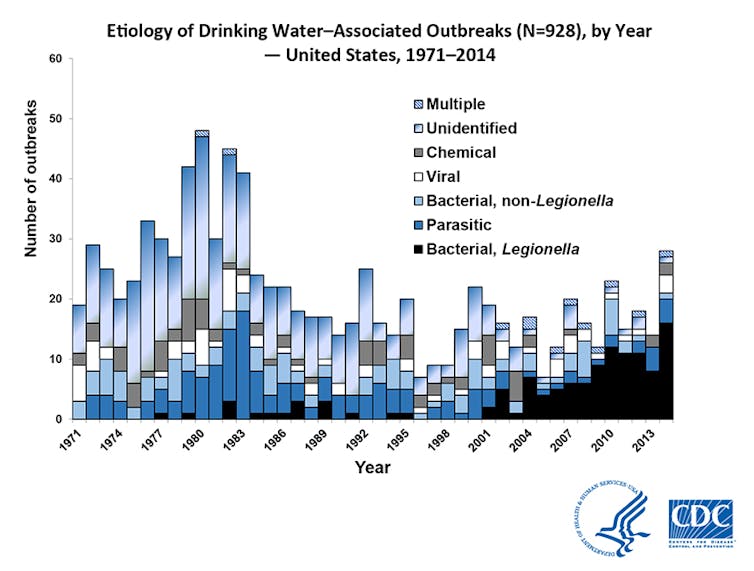
For more than xl years the Safety Drinking Water Human activity has provided a consistent set of national standards for monitoring and managing contaminants to ensure the safety of water. The Environmental Protection Bureau develops these standards and works with states and water utilities to ensure that drinking water supplies conform to them. Thanks to rules implemented nether the Prophylactic Drinking Water Deed in the 1980s waterborne disease declined in the United States just in recent decades has crept back upward.
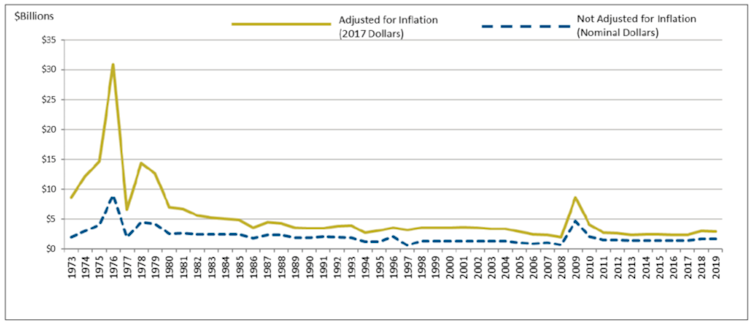
The EPA also provides funding to states and communities to monitor and exam water supplies. This support is essential as the agency develops new standards and monitoring approaches for emerging contaminants, such as PFAS. However, the EPA's almanac appropriations budget for water infrastructure has been almost flat since 2000.
In that location are more than than 151,000 public h2o systems in the United States serving residential communities, schools, function buildings, hospitals and other sites. It is especially challenging for pocket-sized communities to fund infrastructure upgrades and monitor h2o quality. The American Order of Civil Engineers gave the U.S. drinking water delivery arrangement a D on its well-nigh contempo infrastructure report carte, based on the high number of leaks and the presence of both legacy contaminants like lead and new threats like PFAS.
Millions of violations every twelvemonth
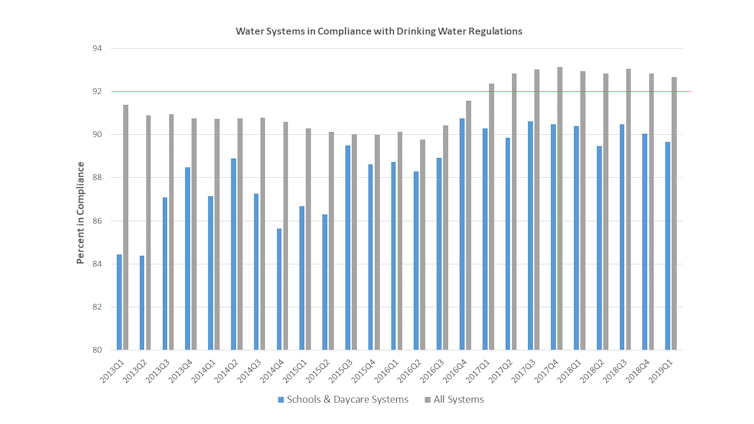
Nationwide, the fraction of all h2o systems in compliance with health standards has hovered between xc% and 93% since 2013. Nevertheless, some key sources are doing less well. For instance, at schools and daycare facilities compliance was only 90% on average from 2014 to 2019, and appears to accept declined in the by several years.
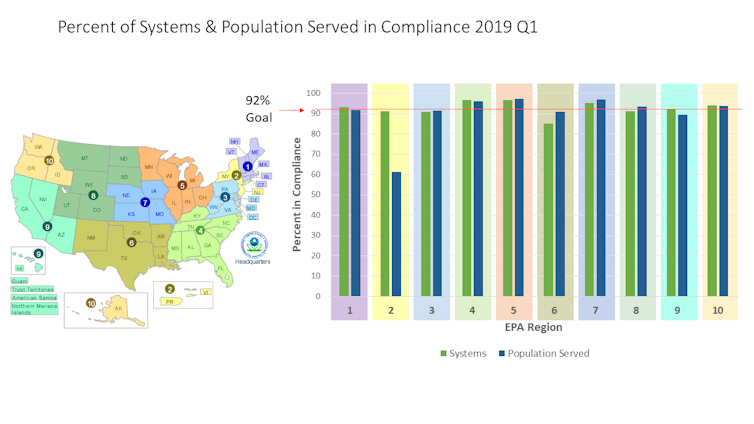
And some regions are better-served than others. EPA data for the offset quarter of 2019 prove that the pct of h2o systems in compliance ranged from 84% to 95%. The fractions of populations with access to water that met all national standards varied even more than, ranging from 60% to 95%. EPA Regions 2 (New York and New Bailiwick of jersey) and 6 (New United mexican states, Texas, Oklahoma, Louisiana and Arkansas) had the poorest compliance records. In Region 2, nearly 12 meg people were served by a system in violation of at least ane federal regulation.
Sickened by tap water
What are the about common violations? Of the x,083 systems that were in violation of a federal standard in 2015, 72% were based on the Full Coliform Rule or other microbial violations. This means that bacteria were constitute in the water, and that there was a potential for waterborne illness due to fecal contamination or inadequate treatment.
Researchers have estimated that every bit many every bit 32 million cases of waterborne disease occur nationwide every year. The most contempo summary from the Centers for Affliction Command of bodily reported problems in community water systems institute 42 outbreaks in 2013 and 2014, with 1,006 cases of affliction, 124 hospitalizations and 13 deaths. For the water manufacture these events represent failures to fulfill its core mission, much like aeroplane crashes for the aviation manufacture.
Climate change is producing more intense storms and flooding, which is significantly affecting water quality. Extreme precipitation and floods wash contaminants from sewage and animal manure into h2o supplies. It is clear that rainfall is associated with widespread transport of fecal contamination from humans and animals into rivers and lakes.
Course: Incomplete
No other industry would take an eight% failure rate, and I do non believe U.S. h2o professionals see that figure equally adequate. In my view, the first step is to put more than resources into water supply monitoring and diagnostics that can discover emerging pathogens, such equally protozoa and viruses.
Early work on the occurrence in water supplies of Cryptosporidium, a microscopic parasite that tin can cause gastrointestinal illness, eventually led to new rules for drinking water monitoring and treatment. Today, water utilities could place whether fecal pollution was coming from humans or animals using new technologies and this would permit them to target impaired waterways before outbreaks occurred.
Another valuable step would exist funding pilot and demonstration plants that could demonstrate new handling systems' potential to reduce waterborne disease risks. For case, in Ohio a consortium of cities, consulting engineers and universities is assessing new treatment systems for combined sewer and stormwater discharges. Creating more such facilities would support innovation and adoption of promising new strategies.
Finally, I believe water providers and regulators should reaffirm their commitment to providing condom water whenever Americans turn on a tap or take a shower. A perfect score may be unattainable today, but fifty-fifty a ane% rise in compliance would make numerous Americans' lives safer and healthier. And investments in new water infrastructure can make 99.999% compliance achievable.

Source: https://theconversation.com/the-us-drinking-water-supply-is-mostly-safe-but-thats-not-good-enough-115028
Posted by: johnsonlopead.blogspot.com
0 Response to "How Clean And Safe Is Your Drinking Water Epa"
Post a Comment